

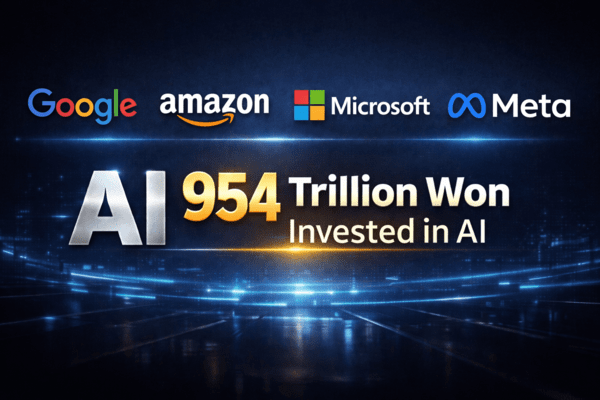
In what economists and analysts are calling the most significant technological race in modern history, the world’s largest technology companies have collectively committed an estimated $650 billion to artificial intelligence over the coming years. This unprecedented wave of investment marks the next major inflection point in computing — one that could redefine global industries, reshape economies, and alter the balance of power in the tech sector.
The surge in AI investment has been driven by a confluence of breakthroughs in large language models, generative AI, and machine learning infrastructure. Companies such as Google, Microsoft, Amazon, Meta, Apple, and NVIDIA are pouring immense resources into building the next generation of intelligent systems, while nations are competing to secure their place in what many now call the “AI century.”
Behind these numbers lies a broader strategic goal: control over the infrastructure, data, and algorithms that will underpin future economic and technological growth. Analysts note that whoever leads in AI will not only dominate software and hardware markets but also set the ethical, economic, and political standards of the digital age.
The $650 billion total reflects not just research and development budgets but also investments in data centers, semiconductor production, and AI startups. NVIDIA alone has seen its valuation skyrocket as the demand for its GPUs — the engines powering modern AI systems — continues to outstrip supply. In parallel, Microsoft’s deep partnership with OpenAI and Google’s rapid releases of Gemini models have sparked a new competitive dynamic that has spread far beyond Silicon Valley.
Yet this is not only about corporate rivalry. Governments are getting involved, too. The U.S., European Union, and China are funding massive AI initiatives, recognizing that leadership in artificial intelligence may prove just as critical to national security as space exploration once was. The race to develop sovereign AI capabilities has become a central geopolitical concern, tying technology directly to questions of economic independence and global influence.
The New Global Race to Dominate Artificial Intelligence
The current AI boom is often compared to historic technological revolutions — the birth of the internet, the rise of the smartphone, or even the dawn of electrical grids. But the scale and pace of today’s advances are setting new records. Artificial intelligence is now seen not as a single technology, but as a foundational platform capable of transforming everything from healthcare and education to manufacturing and defense.
Big Tech’s betting spree reveals how AI has become an essential part of corporate survival strategy. Microsoft’s early lead through its integration of AI copilots into everyday productivity tools has forced competitors to respond with their own breakthroughs. Google’s Gemini and Meta’s open-source LLaMA models have each accelerated innovation, while Apple and Amazon have quietly scaled up internal AI research and acquisitions. Startups, backed by major venture capital rounds, are exploring specialized AI systems for drug discovery, robotics, legal research, and creative collaboration.
Underlying this battle is the struggle for computational power. Training billion-parameter models requires vast energy resources and specialized chips — commodities that are becoming as strategically vital as oil once was. This bottleneck has prompted a parallel race in hardware, with NVIDIA, AMD, Intel, and a rising group of AI-focused chipmakers competing for dominance.
However, the cost of progress is immense. Data centers consume massive amounts of electricity, and ethical challenges continue to raise concern. Questions about privacy, bias, and employment disruption are growing louder as AI becomes integrated into high-stakes decision-making processes. Policymakers are scrambling to craft regulations that encourage innovation without sacrificing accountability or safety.
Despite these concerns, few doubt that AI will be the defining technology of the 21st century. The $650 billion investment wave reflects a global consensus: artificial intelligence is no longer optional — it is imperative. Those who lead in AI development will shape the economic opportunities of the next decades, from automation and personalized medicine to climate modeling and advanced scientific research.
As the world watches this historic race unfold, one truth becomes clear: the competition for AI supremacy is about far more than just technology. It is about the future architecture of global power — and how humanity will coexist with the intelligent systems it is now creating.
This $650 billion bet on artificial intelligence is more than an investment. It is a statement — that the next great transformation of human society has already begun, and there is no turning back.