

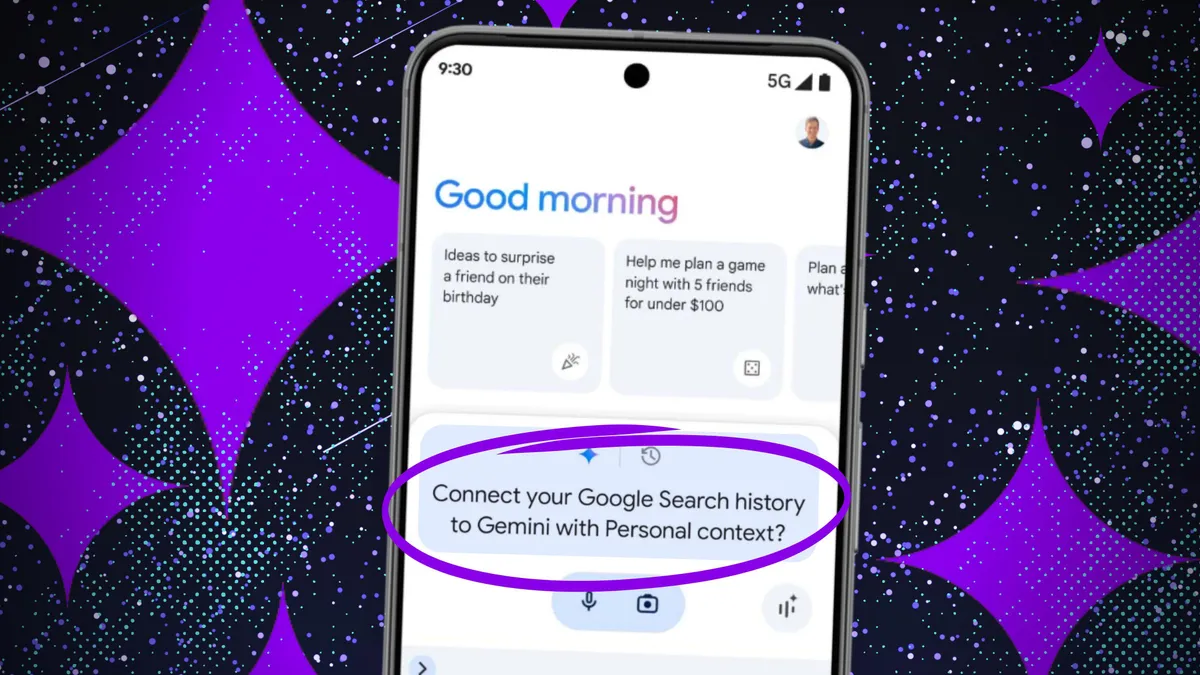
Google has officially taken a major step toward what it calls “personal AI” by deepening the integration of its powerful Gemini model with the user’s digital ecosystem. The company is positioning Gemini not just as another chatbot or productivity assistant, but as a foundational intelligence layer that can seamlessly understand your habits, your preferences, and even your stored data — all to make technology feel more intuitive and responsive.
The announcement underscores a broader shift in the AI race. After years of competing with OpenAI’s ChatGPT and Microsoft’s Copilot, Google appears to have doubled down on personalization as its key differentiator. Gemini, which already powers Google’s AI features in Workspace, Android, and Search, is now gaining authorized access to personal data sources such as Gmail, Google Docs, Drive, Calendar, and Maps (pending user consent). With this level of integration, Gemini can perform tasks that go far beyond simple conversation.
Imagine asking your phone, “When does my passport expire?” and Gemini instantly pulls the answer from a scanned email or image in your Google Drive. Or requesting, “Summarize my last three client meetings and make a follow-up plan,” and having Gemini generate an email draft, a to-do list, and calendar events — all without switching between apps. These are the kinds of experiences Google promises with its increasingly capable model.
Sundar Pichai, Google’s CEO, described this phase as “the beginning of a truly personal AI era,” where Gemini acts as a kind of digital assistant that learns over time, helping users organize, plan, and create in natural ways. The company’s approach tries to retain user control by requiring explicit permissions for each data source, and by allowing users to manage or revoke access at any point. That said, even with these safeguards, the idea of an AI having deep insight into personal files raises important questions about privacy, security, and data ownership.
While Google insists that data used by Gemini remains safely stored within the user’s account — and that it is never used for model training without explicit consent — some experts remain cautious. Past controversies over data usage and inadvertent leaks have shown how complex privacy protection can be when AI systems are involved. Yet, Google’s message is clear: they believe the future of productivity and creativity lies in assistants that truly understand you, not just your queries.
How Gemini’s Data Access Could Redefine Privacy
With this new level of data connectivity, Google is entering uncharted territory. For decades, users trusted Google’s cloud services with their emails, documents, and photos — but those systems largely stayed separate from one another. Gemini blurs that separation by acting as the connective tissue across Google’s ecosystem. It’s an appealing proposition for convenience, but it also redefines what privacy means in the AI age.
In traditional computing, privacy controls were about limiting data collection and access. In the era of personal AI, privacy becomes more about understanding how the data is used — not just who can see it. If a model like Gemini scans your files to answer a question, does that count as data processing or data sharing? When an AI summarizes your week based on emails, travel info, and messages, what safeguards ensure that sensitive details remain confidential? These questions are not hypothetical; they will shape the future of technology governance and consumer trust.
Google has stated that all processing for personal data access will occur within the user’s account, and that Gemini’s responses are generated “ephemerally,” meaning no long-term record of your queries is kept unless you choose to save it. This technical design is intended to reassure users that their digital footprint isn’t growing behind the scenes. However, many analysts note that the very act of centralizing so much information under one intelligent agent could create enticing targets for cyberattacks or misuse, should the protections ever fail.
Beyond the technical and security challenges, there’s also a cultural and philosophical shift at play. AI that “knows” you could become indispensable for daily life — remembering birthdays, optimizing schedules, even predicting needs before you state them. But the closer an AI gets to being truly personal, the harder it becomes to distinguish between helpful assistance and subtle intrusion.
Regulators around the world are taking notice. The EU’s upcoming AI Act, alongside evolving data protection laws, will likely test how “personal AIs” like Gemini comply with transparency, consent, and data locality requirements. Meanwhile, users themselves will need to redefine their comfort levels with automated intelligence that sees their digital life in near-total context.
Still, Google’s gamble may prove prescient. If managed responsibly, Gemini’s expanded access could usher in a new era of AI that feels less like a generic chatbot and more like a genuinely helpful companion — capable of cutting through the noise of modern life and surfacing what really matters. It’s a bold move that merges convenience, power, and risk in equal measure, and it signals that the world’s largest technology companies are shifting their focus from public AI to personal AI, where the user — and their data — sit at the very center of the experience.